Wild Spat vs. Hatchery Single Seed
Oyster farming begins with larval settlement. In regions with reliable warm summer tides and established wild broodstock—such as Arcachon Bay on France’s Atlantic coast or Miyagi Prefecture in northern Japan—growers place limed ceramic tiles, plastic slats, or strings of weathered scallop shells into the water during spawning peaks. Free-swimming veliger larvae attach to these collectors, creating natural "wild-set" spat that must later be scraped apart or grown in clusters.
By contrast, many modern specialty growers rely on land-based marine hatcheries that produce "single seed" oysters settled onto microscopic grains of crushed shell. Single-seed production allows farmers to select uniform cohorts, avoid multi-shell clumps that are hazardous to shuck, and choose between diploid stock (which spawns in warm summer waters) and sterile triploid stock (which redirects reproductive energy toward glycogen storage and year-round firmness). Neither source is inherently superior on the plate; rather, wild-set harvests reflect seasonal local genetics while hatchery seed gives farms predictable shell symmetry.
From Upweller Nurseries to the Estuary
Once oyster seed measures two to four millimetres across, young bivalves are vulnerable to smothering silt, green crabs, and oyster drills. Many operations place seed inside a Floating Upweller System, commonly called a FLUPSY. Using paddlewheels or submersible pumps inside a sheltered dock basin, a FLUPSY draws phytoplankton-rich bay water upward through fine-mesh barrels. Under these controlled conditions, seed grows rapidly to roughly fifteen millimetres before transferring out to exposed estuary leases.
Four Major Grow-Out Systems
After nursery grading, farms diverge into distinct physical architectures suited to local tide ranges, wave fetch, and seabed composition:
| Method | Regional Examples | Shell & Meat Effect | Hospitality Implication |
|---|---|---|---|
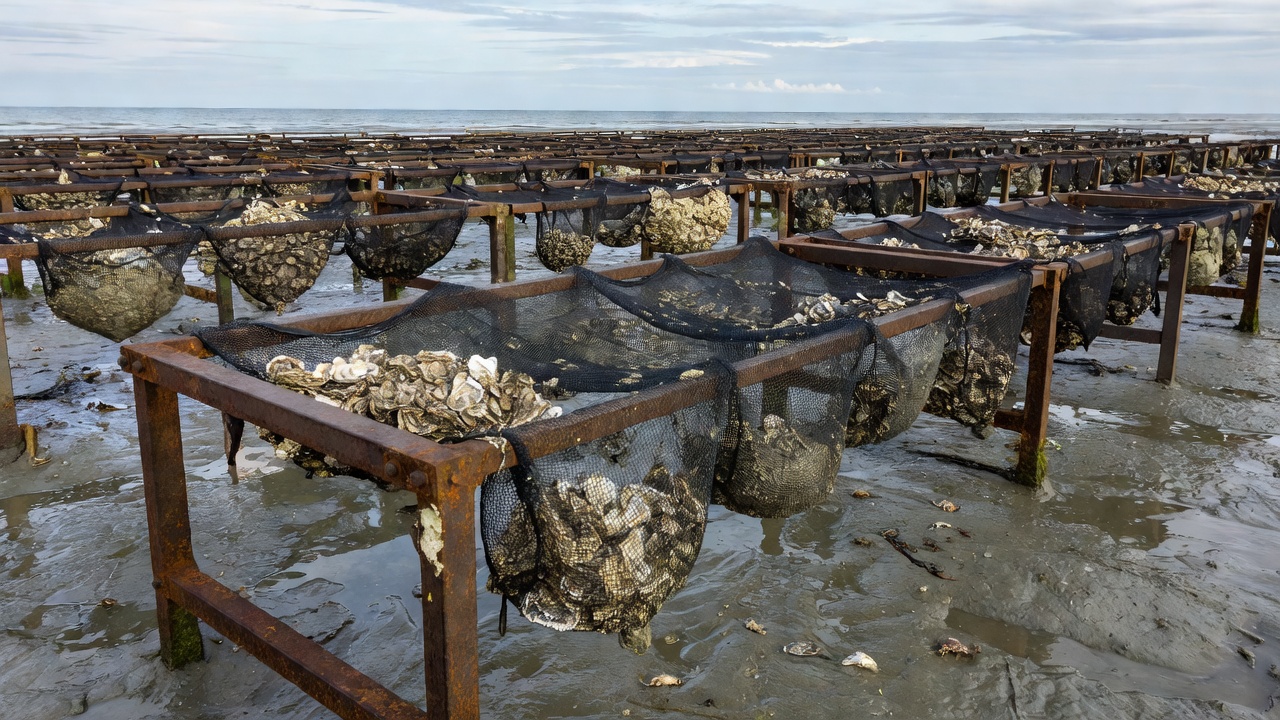
| Intertidal Trestle Bags | Cancale, Normandy, Galway Bay | Periodic air exposure builds sturdy adductor muscle and firm shell edge. | Strong shelf life in cold storage; clean cup for table service. |
| Suspended Flip-Baskets | Coffin Bay, Puget Sound, Tasmania | Tidal rise flips baskets over, chipping fragile fringe to create deep cups. | High meat-to-shell fill and rounded presentation on crushed ice. |
| Deep-Water Rafts & Longlines | Matoya Bay, Akkeshi Bay, Hiroshima | Continuous immersion yields fast growth, delicate fluted shell, plump belly. | Requires gentle hinge shucking; best served shortly after harvest. |
| Bottom Bed Sowing | Limfjord, Whitstable, Chesapeake reefs | Thick, heavy, irregular shells shaped by gravel currents and sea stars. | Rustic appearance; prized for intense mineral complexity in flat oysters. |
Why Farmers Flip, Shake, and Thin
A common misconception among diners is that oysters simply sit untouched until harvest. In practice, growers lift and turn bags every few weeks during warm growing months. In Normandy and Brittany, workers walk the exposed mudflats at low tide to flip heavy mesh sacks ("retournement"), knocking off fouling barnacles and breaking off paper-thin new shell extensions. Without this intervention, an oyster grown in rich current grows long and flat like a tongue, leaving little cavity for meat or liquor.
Similarly, growers routinely haul bags back to shore to pass stock through mechanical drum graders. Lowering bag density from several hundred small oysters to eighty or one hundred market-sized shells prevents stunting and ensures every oyster receives equal plankton flow. Producer claims about "hand-tumbled" or "boutique" stock generally refer to the frequency of this grading and aerial drying cycle.
Pond Finishing in Claires
In the Charente-Maritime region of western France, notably around Marennes-Oléron, growers take cultivation one step further by transferring market-ready Pacific oysters from open tidal racks into shallow, diked earthen salt-marsh ponds known as claires. Stocked at low densities—often five to twenty oysters per square metre—for several weeks to several months, the oysters filter slow-moving marsh water populated by the blue-green diatom Haslea ostrearia.
Observed fact: When digested in sufficient concentration, the pigment marennine from Haslea ostrearia stains the oyster’s gills a visible seafoam green without altering food safety. Tasting language: Diners and affineurs commonly describe claire-finished oysters as rounder and less sharply saline than open-ocean oysters, with faint vegetal notes reminiscent of watercress or damp slate.
Ecological Footprint and Producer Claims
Because oysters are filter feeders that extract naturally occurring microalgae and assimilate calcium carbonate into their shells, aquaculture requires zero external feed, freshwater irrigation, or antibiotics. Academic coastal surveys consistently show that well-sited trestle and rack farms act as three-dimensional habitat structure for juvenile fish and crustaceans while removing excess nitrogen from estuaries upon harvest. However, responsible observers distinguish between general ecosystem benefits and unverified marketing claims: an individual farm’s net ecological impact still depends on vessel fuel use, plastic mesh recovery, and adherence to carrying-capacity limits set by local marine authorities.