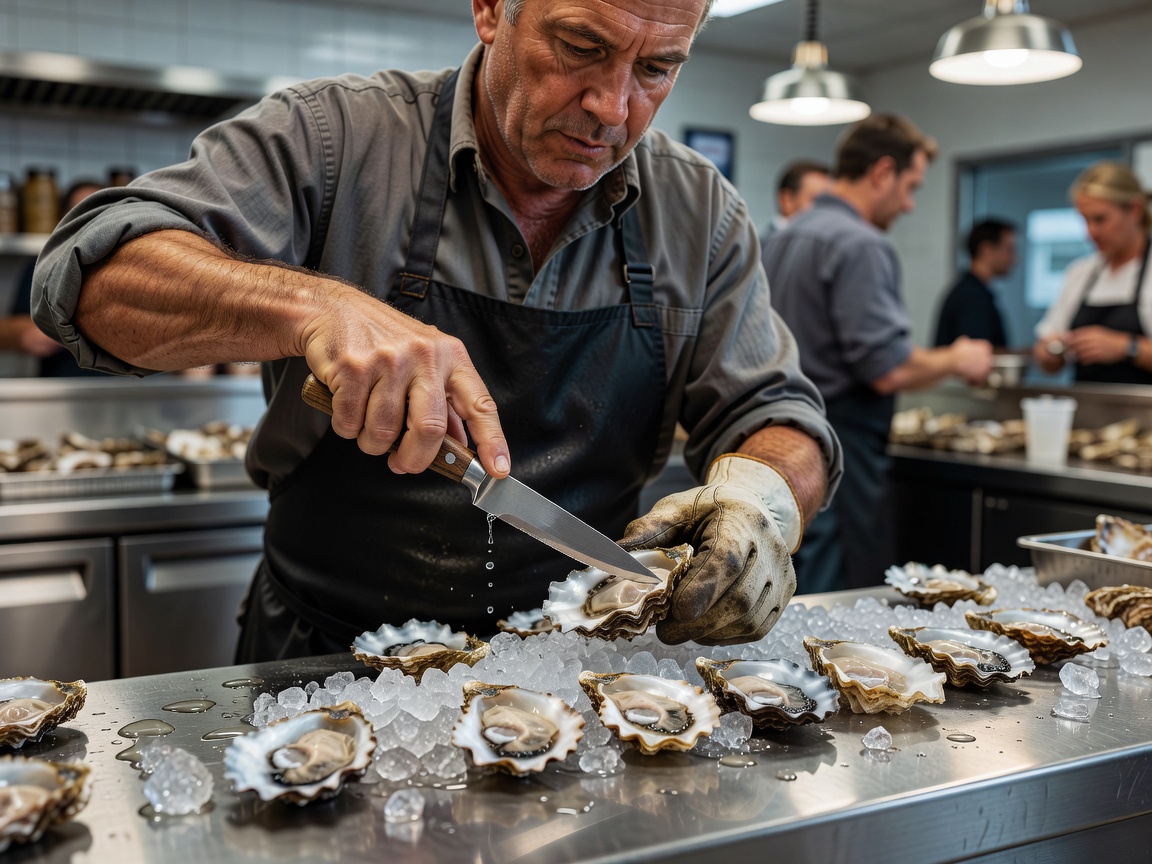
Pre-Shuck Inspection and Rinse
Hospitality starts before the blade touches the shell. Live oysters arriving from coastal wholesalers carry estuarine silt, dried seaweed fragments, or occasional fouling barnacles on their exterior. In disciplined kitchens, shuckers scrub shells lightly under cold running potable water just prior to service—never soaking live oysters in standing freshwater (which stresses and kills marine bivalves) and never rinsing the opened meat afterwards, which washes away the oyster’s natural liquor.
At the same moment, every shell receives a tap-and-inspect check. A healthy oyster keeps its valves tightly clamped or snaps shut firmly when tapped. Any shell gaping open that fails to close after gentle pressure is discarded immediately.
Hinge Entry vs. Side Entry
Professional shuckers generally favour one of two blade entries depending on species geometry and personal control:
- Hinge (Bill) Entry: Using a thick, pointed oyster knife tucked inside a folded bar towel or stainless mesh glove, the shucker works the tip carefully into the hinge ligament at the pointed base, twisting gently with wrist rotation—not brute leverage—until the hinge pops cleanly. Sliding the flat blade tightly along the underside of the top flat valve severs the upper adductor muscle without scratching the soft visceral mass.
- Side (Lip) Entry: Preferred in many French coastal bars for delicate deep-water Crassostrea gigas or round Ostrea edulis, a thinner blade slips gently between the valves beside the adductor muscle (roughly the two-o’clock position on the right side), cutting the upper attachment cleanly before levering the top shell free. Side entry avoids crumbling brittle hinges and keeps shell grit out of the cup.
Regardless of entry point, two technical standards define clean shucking: the bottom cup stays level throughout so the original first liquor remains inside, and the lower adductor attachment is sliced flush against the bottom shell without flipping the oyster upside down to "make it look bigger"—a restaurant shortcut that exposes the torn muscle scar and drains moisture.
Why First Liquor Matters
The clear fluid pooling inside a freshly opened oyster is not trapped seawater; it is balanced mantle fluid regulated by the oyster’s gills and body chemistry. Discarding it or replacing it with melted platter ice strips away salinity, aroma, and mouthfeel. In comparative tastings, guests who sip a drop of undisturbed liquor before chewing the meat immediately perceive the contrast between high-salinity ocean farms and milder brackish estuaries.
Serving Temperature and Time on Ice
Cold storage keeps live oysters dormant at 1°C to 4°C, yet biting straight into an ice-numbed oyster mutes volatile coastal aromatics. Experienced raw bars shuck strictly to order and plate oysters onto fine crushed ice or coarse rock salt so the shell cools steadily around 5°C to 7°C during the ten minutes it takes to reach the table. Leaving pre-shucked oysters sitting under plastic wrap in a prep fridge for hours dries the edges, dulls the sheen, and invites rapid bacterial growth.
A Four-Step Tasting Sequence for Diners
When ordering a mixed flight of two or three regions, sequence and restraint sharpen perception:
- Progress Light to Intense: Start with milder, sweeter oysters (such as Kumamoto or brackish estuary Pacifics), move to crisp Atlantic cupped oysters, and finish with bold, mineral-driven European flats or Sydney rocks.
- Taste the First Specimen Naked: Try at least one oyster from each variety before adding lemon, shallot mignonette, or hot sauce. Notice first the aroma, then the initial brine wave, then chew two or three times to release sweet glycogen and finish notes.
- Apply Acid Sparingly: A single drop of lemon juice or classic red-wine shallot mignonette lifts rich, fatty winter oysters by cutting palate coating, whereas heavy horseradish or thick ketchup-based cocktail sauces completely mask regional character.
- Distinguish Fact from Poetry: Menu adjectives such as "cucumber," "wet stone," or "hazelnut" are subjective tasting language meant as guideposts—not literal ingredients. Sharing simple impressions like "clean brine, short finish" or "creamy body, nutty aftertaste" is every bit as accurate.
Thoughtful Beverage Pairings
High-acid, unoaked white wines such as Muscadet Sèvre et Maine, Chablis, Picpoul de Pinet, or crisp dry Riesling mirror bright coastal brine without metallic clash. Outside wine, dry Pilsners, dry Normandy ciders, cold junmai daiginjo sake, or simple sparkling mineral water with a strip of lemon peel complement oysters smoothly while leaving heavy oak tannins and high-bitterness IPAs aside—since strong oak and hops frequently turn oyster iodine harsh on the finish.